


Mission would deliver First Korean Rover on the Moon
Agreement Highlights Japan-Korea Commercial Aerospace Collaboration
TOKYO–March 31, 2026–ispace, inc. (ispace) (TOKYO: 9348), a global lunar exploration company, and Unmanned Exploration Laboratory (UEL), a space robotics and exploration company in Korea, announced today the signing of a payload service agreement (PSA) to transport a Korean two-wheeled lunar rover to the Moon’s surface aboard ispace’s ULTRA lunar lander for as part of its new Mission 3 (2028).
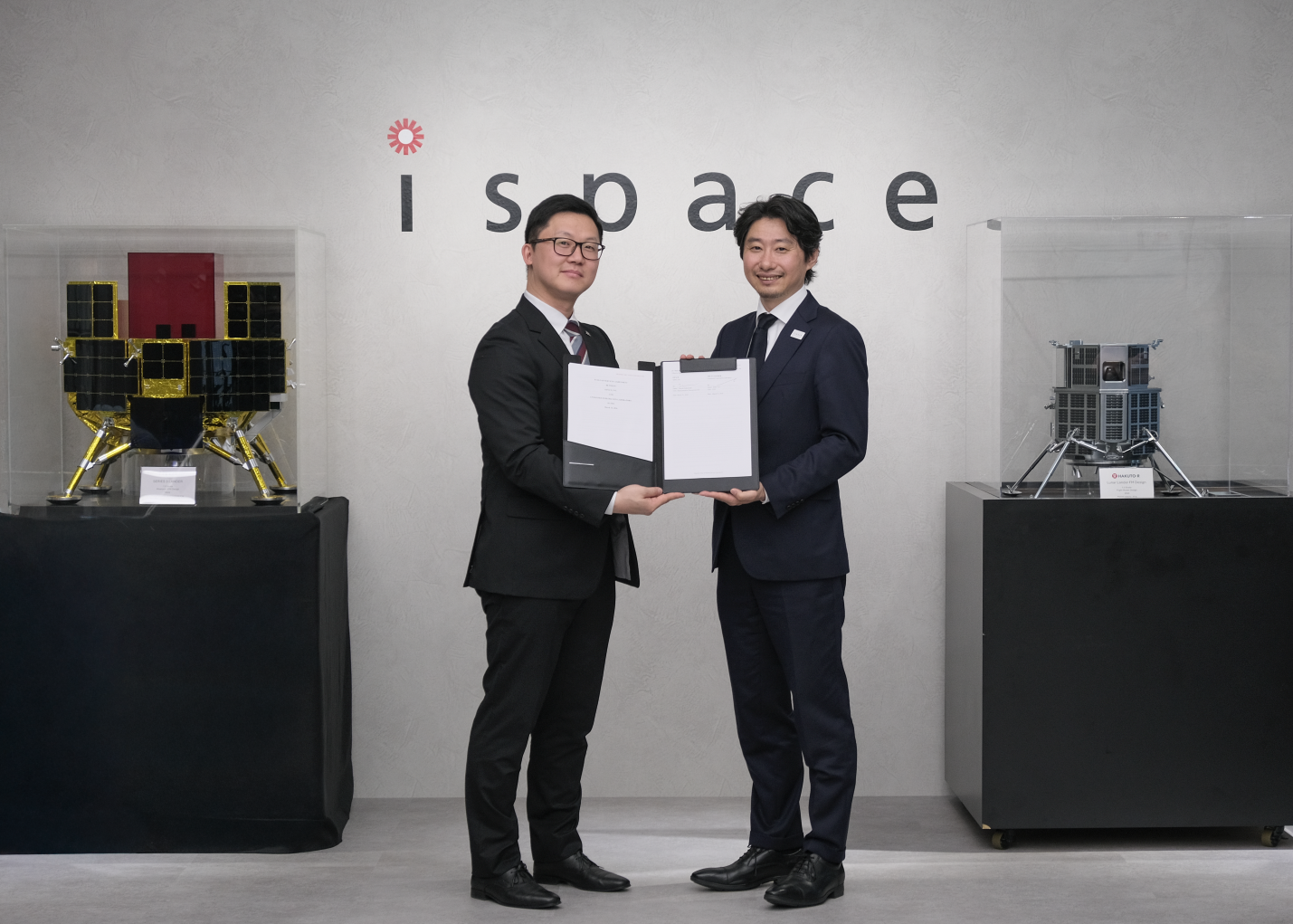
Under the terms of the agreement, the UEL rover will be integrated as a commercial payload on ispace’s ULTRA lunar lander for Mission 3, currently scheduled to launch in 2028. The mission would mark the first Korean rover to explore the Moon’s surface and underscores the growing commercial collaboration between Japan and Korea in the aerospace industry.
Mission 3 will serve as the inaugural flight for ispace’s ULTRA lunar lander. Supported by a Small Business Innovation Research (SBIR) grant from Japan’s Ministry of Economy, Trade, and Industry (METI), the ULTRA lander represents a significant step forward in the company’s early commercialization phase.
UEL’s SCARAB rover is a two-wheeled, 2-kg class micro-rover. This mission has the goal of establishing space heritage through a technology demonstration with the primary objective during the rover’s first mission to acquire image data during the lunar day. It will perform verification of the entire exploration system by capturing images of the lander and its payloads in a “lander-selfie rover” configuration utilizing two cameras to generate precise 3D images. Additionally, the SCARAB rover comes with an internal bay that can accommodate up to 200g of payloads. The rover deployment relies on a simple quick-release mechanism that eliminates complex structures to minimize mass. The rover is expected to play a key role in conducting initial technology demonstrations for Korea’s lunar exploration missions.
The PSA builds upon the strong collaborative foundation established between the two companies during the past two years. The payload transportation partnership was initially formalized through a memorandum of understanding (MOU) announced in October 2024, which was followed by an interim payload service agreement (iPSA) signed at the International Astronautical Congress (IAC) in October 2025. As outlined in the iPSA, a second rover is expected to be manifested on a future ispace mission, and a separate PSA will be announced once finalized.
In addition to securing payload delivery services for Mission 3, ispace and UEL will enter into negotiations for a contract to transport a subsequent UEL payload on a lunar mission. This commitment emphasizes the shared vision of both companies to accelerate the cislunar economy and expand lunar surface mobility services.
Statement of Takeshi Hakamada, Founder & CEO of ispace
“This payload service agreement demonstrates ispace’s collaborative and incremental approach, serving global space exploration companies in their efforts to deliver and test their technology on the Moon’s surface. ispace continues to support pioneers around the world by providing lunar transportation services to realize technology demonstrations with agility and speed,” said Takeshi Hakamada, Founder & CEO of ispace.
Statement of Jaeho Lee, CEO of UEL
“With this agreement, UEL aims to be the first Korean company to conduct a privately-led mission to the lunar surface. This will demonstrate our technological maturity to the global space market and validate new business models. UEL aims to support humanity’s exploration to deep space and beyond – including Mars – by conducting robotic missions that acquire valuable information for future crewed missions. We hope to adapt technologies for surviving extreme environments in space into markets providing mobility solutions for extreme conditions on Earth,” said Jaeho Lee, CEO of UEL.
About ispace, inc. (https://ispace-inc.com)
ispace, a global lunar resource development company with the vision, “Expand our planet. Expand our future.”, specializes in designing and building lunar landers and rovers. ispace aims to extend the sphere of human life into space and create a sustainable world by providing high-frequency, low-cost transportation services to the Moon. The company has business entities in Japan, Luxembourg, and the United States with more than 300 employees worldwide. For more information, visit: www.ispace-inc.com and follow us on X: @ispace_inc.
About UEL (www.uel.co.kr)
Unmanned Exploration Laboratory (UEL) is Korea’s first and only startup dedicated to lunar rover development. UEL develops compact rovers with payload capacities ranging from 200g to 10 kg, as well as a variety of foldable and deployable rover platforms designed for autonomous operations in harsh lunar environments. UEL’s near-term vision is to enable In-Situ Resource Utilization (ISRU) for future lunar resource mining, while its long-term vision is to support habitat construction and ultimately enable the return of valuable resources from the Moon.
UEL is a KARI Family Member Company, an LG Super Startup, 4th Generation IBK “Changgong” startup, and a KICT Smart Construction Support Center resident company.