

ispace

Contact us.
Please fill out below contact form after selecting the appropriate category.

  • General
  • Services & Sales
  • Media
  • Career
  • Investor Relations

* mandatory
This site is protected by reCAPTCHA.
The Google Privacy Policy and Terms of Service related to reCAPTCHA apply.
ispace, inc

Nihonbashi Honcho M-SQUARE 6F, 1-9-3, Nihonbashi Honcho, Chuo-ku, Tokyo Japan

103-0023

ispace U.S.

Colorado 12876 E Adam Aircraft Circle, Centennial,
CO 80112, United States
Denver, US

ispace Europe

5 Rue de l’Industrie 1811,
Luxembourg

ispace-EUROPE and ALTEC Sign Memorandum of Understanding to Collaborate on Lunar Rover Testing

Luxembourg / Turin, 12 October – ispace-EUROPE S.A. (“ispace-EUROPE”), the Luxembourg-based European entity of ispace, inc. (“ispace”), and ALTEC – Aerospace Logistics Technology Engineering Company S.p.A. (“ALTEC”), an Italian centre of excellence for engineering and logistics services supporting space operations and planetary exploration missions, have signed a Memorandum of Understanding (“MoU”) to explore collaboration on lunar rover testing, mission simulations and operational training.
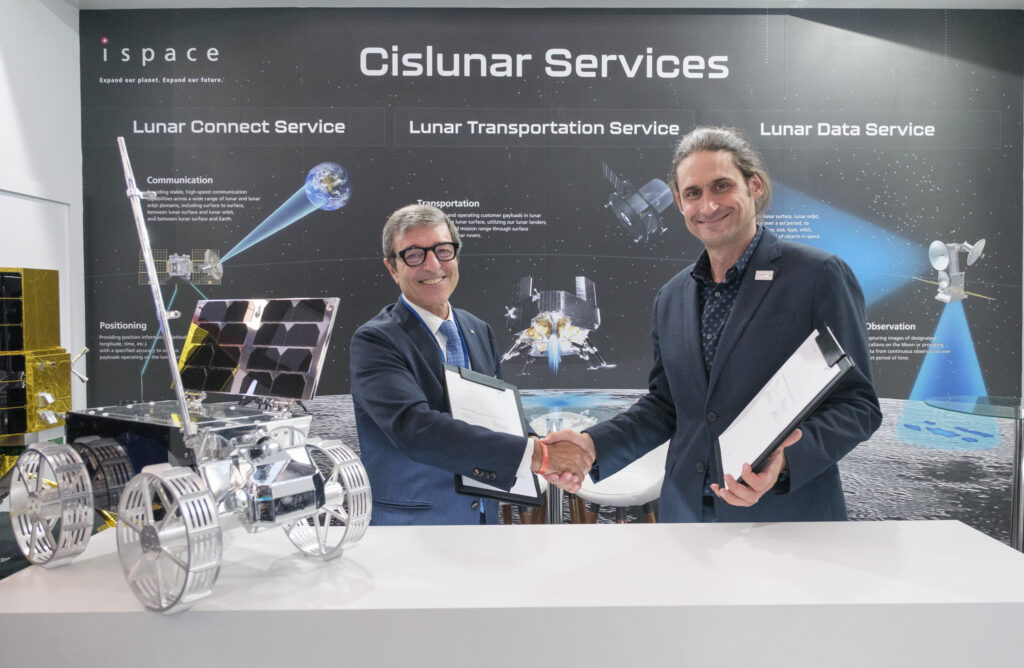
Vincenzo Giorgio, CEO of ALTEC, and Julien-Alexandre Lamamy, CEO of ispace-EUROPE, following the ceremonial signing of the MoU at the 77th International Astronautical Congress (IAC) in Antalya, Türkiye.

Under the MoU, ispace-EUROPE and ALTEC will assess opportunities for ispace-EUROPE to use ALTEC facilities to simulate rover platform operations in lunar analogue environments. The collaboration may include functional testing of lunar rover platforms and ancillary devices, mission simulations, operator rehearsals, subsystem and system-level verification and validation activities, and targeted training and certification campaigns for ispace-EUROPE’s lunar mission operations team. The agreement will also explore broader cooperation potentially related to lunar exploration technologies, lunar mobility, and space resource utilization.

Based in Turin, Italy, ALTEC is a public-private company owned by Thales Alenia Space and the Italian Space Agency (ASI). Since 2019, ALTEC has operated the Rover Operations Control Centre (ROCC), the mission control facility for ESA’s ExoMars Rosalind Franklin rover, which is currently used for ground testing of rover systems. ALTEC is also developing a new Lunar Simulation Centre, funded by the Italian Space Agency (ASI), dedicated to the simulation and testing of robotic lunar exploration missions and related operational activities. The new facility will provide analogue environments and capabilities to support the testing and validation of technologies, systems and operational concepts for future lunar missions, further strengthening Italy’s role in planetary exploration.

For ispace-EUROPE, the collaboration represents an important opportunity to expand access to specialized European testing and mission operations infrastructure as the company advances its family of lunar rover systems and future surface mobility missions.

Julien-Alexandre Lamamy, CEO of ispace-EUROPE, said: “Testing, simulation and operator training in analogue lunar environments are essential to successful lunar surface operations. Through this collaboration with ALTEC, we have the opportunity to bring together ispace-EUROPE’s expertise in lunar rover development and operations with ALTEC’s advanced lunar analogue facilities, as well as their expertise testing for planetary mission operations.

“This agreement reflects the growing strength of Europe’s lunar exploration ecosystem. By working with leading partners across Europe, like ALTEC, we can accelerate the development of robust, operationally ready rover systems that support future science, exploration and space resource utilization missions on the Moon.”

Vincenzo Giorgio, CEO of ALTEC, said: “This MoU with ispace-EUROPE is an opportunity to build on ALTEC’s experience in planetary mission operations and to further develop our capabilities in support of future lunar exploration. The development of our new Lunar Simulation Centre, funded by the Italian Space Agency, will provide an important platform for testing, simulation and operational support of robotic lunar missions. We look forward to exploring with ispace-EUROPE how these capabilities can support the development, validation and operations of lunar rover technologies and contribute to a stronger European lunar exploration ecosystem.”

As lunar exploration moves toward more frequent and complex surface missions, the ability to test, validate, and rehearse rover operations in realistic analogue environments will become increasingly important. This MoU supports the development of European capability in this area and reinforces the shared ambition of both organizations to enable safe, reliable and effective lunar surface operations.

###

About ispace, inc. (https://ispace-inc.com)

ispace, a global lunar exploration company with the vision, “Expand our planet. Expand our future.”, specializes in designing and building lunar landers, orbital transfer vehicles and rovers. ispace aims to extend the sphere of human life into space and create a sustainable world by providing high-frequency, low-cost transportation services to the Moon. The company has business entities in Japan, Luxembourg, the United States and Saudi Arabia, with more than 300 employees worldwide. For more information, visit: www.ispace-inc.com and follow us on X: @ispace_inc.

About ALTEC (www.atlecspace.it)

ALTEC – Aerospace Logistics Technology Engineering Company S.p.A. is an Italian public-private company owned by Thales Alenia Space and the Italian Space Agency (ASI), based in Turin, Italy. With more than 20 years of experience, ALTEC provides engineering, logistics and operational services supporting human and robotic space exploration and planetary missions. Since 2019, ALTEC has operated the Rover Operations Control Centre (ROCC) for ESA’s ExoMars Rosalind Franklin mission and is developing new capabilities for future lunar robotic missions, including a Lunar Simulation Centre funded by the Italian Space Agency (ASI). For more information, visit: www.altecspace.it. and follow us on LinkedIn @Altec-spa
1 MB PDF

Related articles

Mission
Argo Space and ispace-U.S. Head to the Moon with Finalized Contract for Lunar Satellite Delivery “Mission 2.5”
Learn More
Mission
ESA and ispace-EUROPE Mark Official Signing of Europe’s First Lunar Polar Ice Exploration Rover Mission
Learn More
Mission
ispace Receives Grant for Japan’s Space Strategy Fund Project “High-Precision Landing Technology in the Lunar Poles Region”
Learn More

ispace and ArianeGroup Sign Agreement for Strategic Collaboration to Advance Lunar Spacecraft Development

MOU establishes framework for cooperation on ULTRA lunar lander propulsion and AIT services, and explores expanded collaboration for future lunar spacecraft and missions

Türkiye—October 6, 2026—ispace, inc. (ispace) (TOKYO: 9348), a global lunar exploration company, and ArianeGroup, a French-German leader in space technology, have agreed to explore expanded cooperation supporting ispace’s current and future lunar spacecraft and missions. The two companies signed a memorandum of understanding (MOU) on October 6 at the IAF’s International Astronautical Congress 2026 in Antalya, Türkiye.

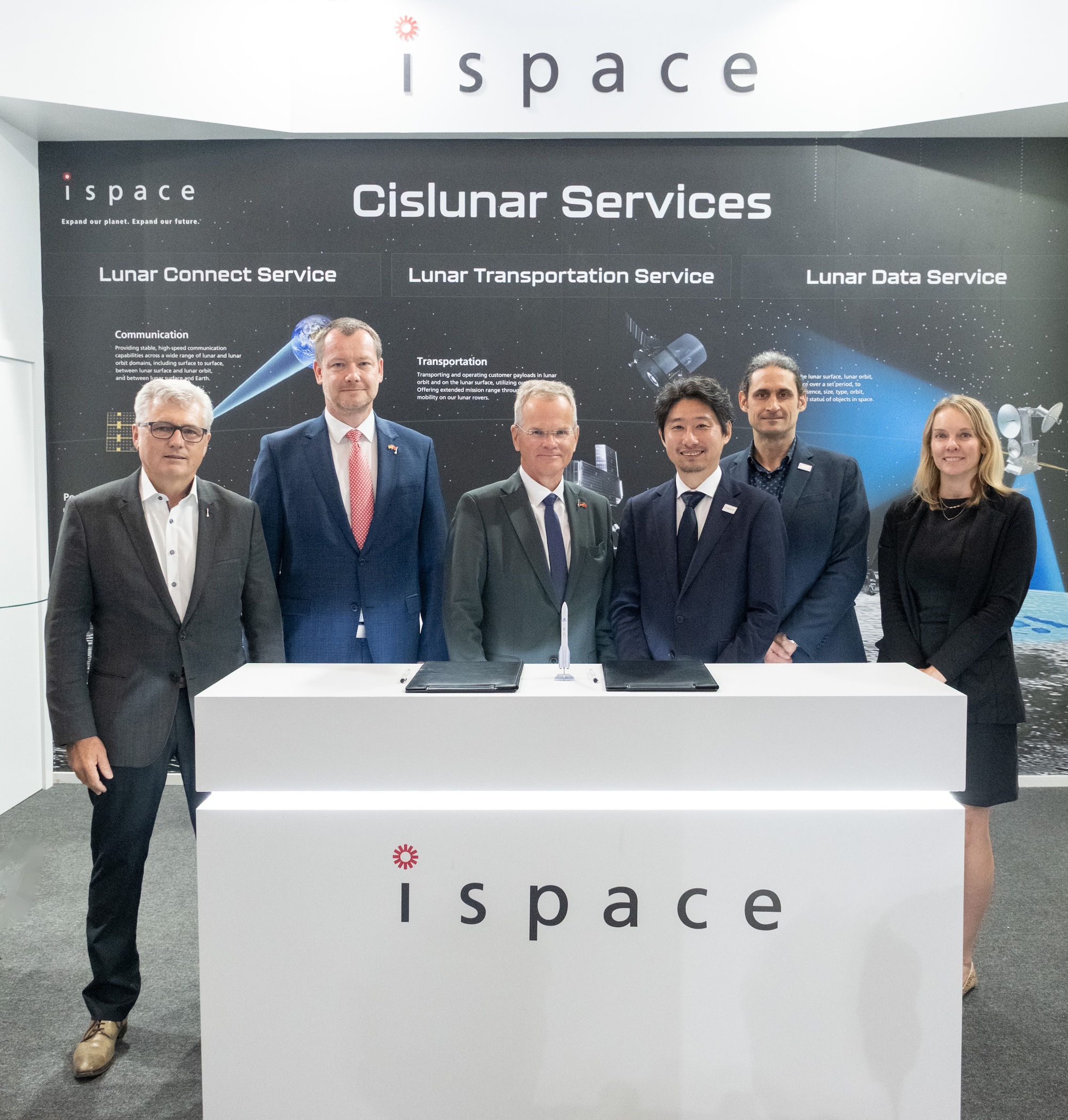
Markus Thiel, Head of Engineering and Design at ArianeGroup GmbH, Timo Krone, Senior Business Development Manager at ArianeGroup GmbH, Dr. Stefan Ziegenhagen, Head of Orbital Products, Equipment & Services of ArianeGroup GmbH, Takeshi Hakamada, Founder & CEO of ispace, inc., Julien-Alexandre Lamamy, CEO of ispace-EUROPE, and Elizabeth Kryst, CEO of ispace-U.S., following the signing of the MOU at the 77th International Astronautical Congress (IAC) in Antalya, Türkiye.

Building on ArianeGroup’s extensive flight heritage and experience in space systems, ispace has selected ArianeGroup pulsing thrusters and reaction control system (RCS) thruster hardware for integration into its ULTRA lunar landers. ArianeGroup is also contracted to provide related assembly, integration, and testing (AIT) services in support of the development.

Through the MOU, ispace and ArianeGroup intend to explore new opportunities to expand their collaboration beyond the ULTRA lander program. With ispace-EUROPE and ispace-U.S. as co-signatories, the agreement is expected to fortify current and future ispace missions in Japan, Europe, the United States, and other mutually agreed markets.

The companies will also evaluate long-term commercial agreements aimed at supporting stable lander production and enabling ispace’s targeted launch cadence. Through these arrangements, ispace and ArianeGroup aim to work together to further improve mutual lead times, reliability, and quality, and delivering consistent customer value as ispace continues to enrich its capabilities and offerings for future lunar missions.

The agreement builds on a longstanding relationship between ispace and ArianeGroup, including collaboration on propulsion components and assembly, integration, and testing for ispace’s Mission 1 lunar lander at ArianeGroup’s facility in Lampoldshausen, Germany. In 2021, ispace-EUROPE and ArianeGroup were also jointly selected by the European Space Agency (ESA) to participate in a pilot phase aimed at establishing commercial partnerships for lunar transportation and exploration.

Through this expanded collaboration, ispace and ArianeGroup aim to leverage their respective capabilities and experience to support reliable spacecraft development and production, while exploring opportunities to work together across future lunar missions and spacecraft programs.

Statement of Takeshi Hakamada, Founder & CEO of ispace, inc.

“As ispace works toward a regular cadence of missions to the Moon, establishing strong, long-term relationships with experienced partners will be essential to scaling our spacecraft development and production capabilities. ArianeGroup brings extensive flight heritage and technical expertise, and we look forward to exploring how our respective capabilities can support not only the ULTRA lunar lander, but future ispace spacecraft and missions from our global organization,” said Takeshi Hakamada, Founder & CEO, ispace, inc.

Statement of Julien-Alexandre Lamamy, CEO of ispace-EUROPE

“This agreement is an important step toward strengthening Europe’s role in the lunar economy. At ispace-Europe, we are committed to building strong industrial partnerships that advance Europe’s lunar ambitions. By combining our expertise, we can accelerate the delivery of competitive technologies and services for lunar exploration”

 Statement of Stefan Ziegenhagen, Head of Orbital Products, Equipments & Services of ArianeGroup GmbH

“The Orbital Propulsion Team from ArianeGroup is thrilled to continue the cooperation with ispace. This MoU reinforces the trusted relationship between our companies and underscores our common goal: combining technological excellence with the vision to explore the moon.”

Statement of Markus Abele, Sr. Business Dev. Manager of ArianeGroup GmbH

“This agreement marks a major new chapter in the relationship between our two companies. After eight successful years working together on cutting-edge technologies, we are expanding the collaboration in the area of future size lander systems as well as orbital applications.”

About ispace, inc. (https://ispace-inc.com)

ispace, a global lunar resource development company with the vision, “Expand our planet. Expand our future.”, specializes in designing and building lunar landers and rovers. ispace aims to extend the sphere of human life into space and create a sustainable world by providing high-frequency, low-cost transportation services to the Moon. The company has business entities in Japan, Luxembourg, and the United States with more than 300 employees worldwide. For more information, visit: www.ispace-inc.com and follow us on X: @ispace_inc.

About ArianeGroup

ArianeGroup is an industrial company delivering critical missions for the space and defence sectors. With 8,700 highly qualified employees in France and Germany, ArianeGroup has unique expertise in access to space, covering the full spectrum of civil and military launch systems, including design, development, manufacturing, integration, flight preparation, operational readiness and end-of-life decommissioning.

ArianeGroup is lead contractor for the Ariane 6 European launcher for the European Space Agency (ESA), and for the French oceanic deterrent force M51 strategic missile for the French Defence Armament Procurement Agency (DGA). Internationally recognised for its innovative, competitive solutions, ArianeGroup has expertise in state-of-the-art technologies, from the chemistry of propellants and composite materials, to liquid, solid and electric space propulsion systems.

ArianeGroup also offers a broad range of space, defence and industrial equipment and services, both individually and together with its subsidiaries Sodern, Pyroalliance, Nuclétudes and APP. In the field of space launchers, ArianeGroup’s subsidiary Arianespace markets Ariane 6, and its subsidiary MaiaSpace develops and markets the reusable launcher Maia.

ArianeGroup, equally owned by Airbus and Safran, posted consolidated revenues of €2.6 billion in 2025.

2 MB PDF

Related articles

Corporate
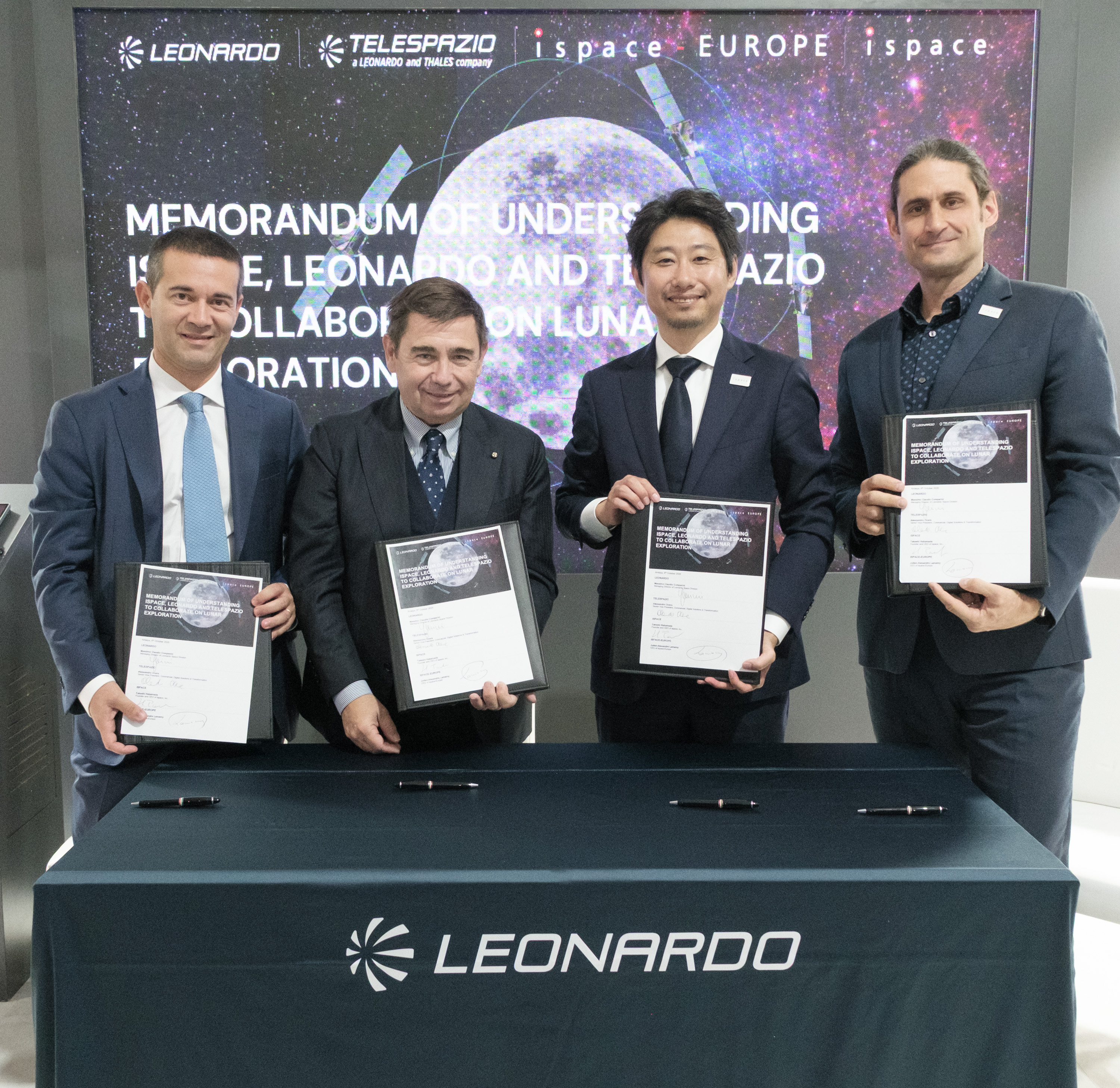
ispace, Leonardo and Telespazio Sign Memorandum of Understanding to Collaborate on Lunar Exploration
Learn More
Corporate
ispace Launches New Program “Engineering Master Program”
Learn More
Corporate
ispace Announces Reappointment of Board Members
Learn More

ispace, Leonardo and Telespazio Sign Memorandum of Understanding to Collaborate on Lunar Exploration

  • The MoU builds on existing cooperation between ispace and Telespazio further expanding the areas of potential cooperation also leveraging on Leonardo space capabilities in robotics and AI applied to space exploration, strengthening Europe’s and Japan roles in the emerging cislunar economy.
  • The partnership will advance interoperability of lunar infrastructure and services to support global lunar exploration and explore ispace’s lunar transportation capabilities, with the European Space Agency’s Moonlight programme led by Telespazio, part of Leonardo Group, being the first opportunity to implement it.


Luxembourg / Tokyo / Rome, 6th October 2026 – ispace-EUROPE S.A. (“ispace-EUROPE”) and ispace, inc. (collectively “ispace” – a leading global lunar exploration company), have signed a Memorandum of Understanding (MoU) with Leonardo, a leading global aerospace, defense, and security player and Telespazio, a joint venture between Leonardo (67%) and Thales (33%), to explore collaboration on lunar communications, positioning, navigation and timing (PNT) infrastructure and services, and lunar transportation partnership.

Alessandro Ocera, SVP, Commercial, Digital Solutions & Transformation of Telespazio, Massimo Claudio Comparini, Managing Director of Leonardo Space Division, Takeshi Hakamada, Founder & CEO of ispace, inc., & Julien-Alexandre Lamamy, CEO of ispace-EUROPE, following the signing of the MOU at the 77th International Astronautical Congress (IAC) in Antalya, Türkiye. 

This new agreement expands upon the previous cooperation between ispace and Telespazio, originally built on their initial 2025 Letter of Intent, including the possibility to explore Leonardo’s space division capabilities in space robotics and AI applied to space exploration, as well as by broadening the scope of collaboration with additional strategic areas like interoperability, user access and service provision to expand lunar communications, navigation, and transportation services. Reflecting a shared commitment to support global lunar exploration missions, the partnership also focuses on the development of user terminals, space and ground segments to meet the demands of tomorrow.

Together, the parties will evaluate how integrated service offerings could provide expanded communications coverage on the lunar surface and to lunar orbit, expanded navigation capabilities, increased data capacity, and improved resilience for future lunar missions.  The MOU also includes exploring the potential transportation of Moonlight satellites to lunar orbit by ispace’s orbital transfer vehicle.

The inclusion of both ispace’s Japanese and European entities, alongside the international excellence of Leonardo and Telespazio, brings together complementary strengths from across Europe and Japan — enabling deeper international collaboration on the infrastructure, services and standards needed to support future lunar activity.

Takeshi Hakamada, Founder and CEO of ispace, said: “Through this collaboration with Telespazio and Leonardo we are bringing together complementary capabilities in transportation, communications and navigation to help build the foundations of a sustainable cislunar economy. We are proud to work alongside leading European partners to advance the infrastructure that will support the next generation of lunar missions.”

Julien-Alexandre Lamamy, CEO of ispace-EUROPE, said: “This collaboration is particularly exciting because it brings together some of the strongest lunar exploration capabilities across Europe and Japan to support a shared vision: enabling advanced lunar missions by both commercial and government actors that will achieve sustained exploration and long-term presence on the Moon.” By combining European expertise in telecommunications, navigation and space systems with ispace’s experience in lunar transportation, communications and surface mobility, we have an opportunity to help shaping the infrastructure that future missions will rely upon.”

Massimo Claudio Comparini, Managing Director of Leonardo Space Division said “The agreement with ispace marks a further step towards the development of an always more integrated and interoperable infrastructure capable of supporting the growing number of missions to the Moon. By bringing together complementary capabilities in communications, navigation and lunar transportation, robotics and AI, Leonardo, together with Telespazio and Thales Alenia Space, is contributing to the development of the services and technologies that will enable a sustained presence in the lunar environment, supporting the evolution of a global and interconnected cislunar ecosystem.”

Gabriele Pieralli, Chief Executive Officer of Telespazio said: “With this collaboration, Telespazio consolidates its leading role in lunar communication and navigation infrastructure, bringing together Moonlight’s expertise with ispace’s cislunar transportation and communication capabilities, mission interoperability and Leonardo’s technological depth. This step strengthens Italian and European industrial leadership, enhancing collaboration with ispace as primary industry in what is set to become a lunar economy — a strategic asset for science, industry, and institutional missions in the decades ahead”

As global lunar exploration transitions from individual missions to a sustained operational ecosystem, communications, navigation and transportation infrastructure are increasingly recognized as critical enablers of scientific, commercial and governmental activities on the lunar surface and in lunar orbit. The parties believe that collaboration and interoperability will be essential to creating a resilient lunar ecosystem.

About ispace, inc. (https://ispace-inc.com)

ispace, a global lunar exploration company with the vision, “Expand our planet. Expand our future.”, specializes in designing and building lunar landers, orbital transfer vehicles and rovers. ispace aims to extend the sphere of human life into space and create a sustainable world by providing high-frequency, low-cost transportation services to the Moon. The company has business entities in Japan, Luxembourg, the United States and Saudi Arabia, with more than 300 employees worldwide. For more information, visit: www.ispace-inc.com and follow us on X: @ispace_inc.  

3 MB PDF

Related articles

Corporate
ispace and ArianeGroup Sign Agreement for Strategic Collaboration to Advance Lunar Spacecraft Development
Learn More
Corporate
ispace Launches New Program “Engineering Master Program”
Learn More
Corporate
ispace Announces Reappointment of Board Members
Learn More

Argo Space and ispace-U.S. Head to the Moon with Finalized Contract for Lunar Satellite Delivery “Mission 2.5”

EL SEGUNDO, Calif. / DENVER—September 17, 2026— ispace technologies U.S. (ispace-U.S.), a subsidiary of ispace, inc. (ispace) (TOKYO: 9348), a global lunar exploration company, and Argo Space Corp. (Argo) executed a definitive agreement under which Argo will deliver ispace’s Lunar Connect communication relay satellite to lunar orbit.

This signing finalizes the agreement the two companies announced in March 2026 and clears the way for the mission, ispace Mission 2.5, to launch as early as 2027.

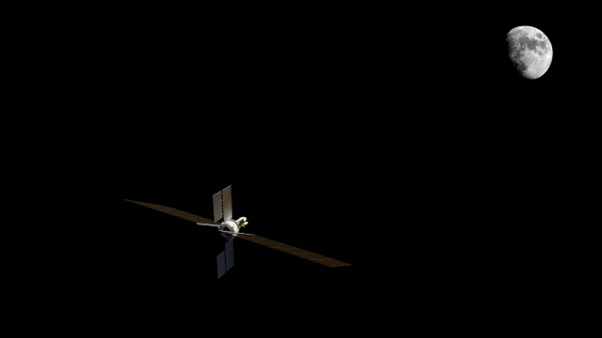
A computer-generated image of the Argonaut vehicle transferring Alpine to lunar orbit.

The satellite, named Alpine after the imagery of the Colorado Rocky Mountains just outside ispace’s U.S. headquarters, will become the first orbital asset in ispace’s Lunar Connect Service, a planned constellation providing communications and positioning services across the lunar surface and lunar orbit. Argo will transport the satellite to lunar orbit using its Argonaut water-powered space logistics vehicle. Argonaut is uniquely architected to provide next-generation mobility and responsive, affordable delivery of customer assets to any orbit, including cislunar space.

ispace’s Lunar Connect Service will employ a constellation of at least five satellites orbiting the Moon to provide communication, positioning, observation, and Space Situational Awareness (SSA) for customers seeking to engage in the cislunar economy. The remaining satellites are expected to be deployed into lunar orbit by 2030. ispace plans to utilize a variety of methods for the transportation of lunar orbit satellites, including its own lunar landers and orbital transfer vehicles (“OTVs”), as well as third-party transportation services such as those provided by Argo.

ispace-U.S. is an American lunar exploration company based in Englewood, Colo. It provides transportation services to the lunar surface and lunar orbit as well as infrastructure capabilities for government, academic, and commercial customers.

With NASA’s recent announcement of IGNITION and its plans to develop a Moon Base as a central component of the agency’s Artemis program, ispace-U.S. is positioning itself to acquire future Commercial Lunar Payload Service (CLPS) task orders from NASA, as well as private payload service contracts to support the operations near the lunar South Pole. Based on its proven spaceflight heritage; extensive mission control operations; and assembly, integration, and testing (AIT) experience, ispace and ispace-U.S. intend to lead the development of a vibrant cislunar economy that connects the Earth and the Moon. 

Statement of Elizabeth Kryst, CEO of ispace-U.S.

“The lunar economy will be built on infrastructure, and infrastructure starts with the first asset in orbit. This mission allows us to deploy our first Lunar Connect satellite and deliver communications and positioning services around the Moon. Argo’s transportation capabilities let us move faster as activity on and around the Moon accelerates,” said Elizabeth Kryst, CEO of ispace-U.S.

Statement of Robert Carlisle, CEO of Argo Space Corp.

“This mission exemplifies how commercial companies can collaborate to increase access to the Moon in support of both commercial applications and NASA’s ambitious Lunar programs. This is a meaningful step toward the affordable, high-throughput logistics network needed to enable and catalyze a Lunar economy. Argo is proud to support ispace with our transportation service. This mission will provide a strong demonstration of how Argo’s multi-modal transportation model can support the next generation of space infrastructure and capabilities.”

About ispace-U.S.

ispace-U.S. is an American lunar exploration company providing transportation and infrastructure capabilities from Earth to lunar orbit and the surface of the Moon for government and commercial customers. ispace believes that the utilization of lunar resources is the catalyst for enabling human permanence and economic opportunity on and around the Moon and is committed to achieving this goal.

For more information, follow us on LinkedIn and X: @ispace_us_inc

About Argo

Argo Space designs, builds, and operates high-performance, refuellable spacecraft that deliver customer assets to any orbit and provide unprecedented mobility on orbit. Argo’s vehicles run on water — launched from Earth today, sourced from the Moon tomorrow — to power an in-space logistics system that will catalyze a Lunar economy and the industrial space age. Argo is headquartered in El Segundo, California. For more information, visit www.argospace.com.

246 KB PDF

Related articles

Mission
ispace-EUROPE and ALTEC Sign Memorandum of Understanding to Collaborate on Lunar Rover Testing
Learn More
Mission
ESA and ispace-EUROPE Mark Official Signing of Europe’s First Lunar Polar Ice Exploration Rover Mission
Learn More
Mission
ispace Receives Grant for Japan’s Space Strategy Fund Project “High-Precision Landing Technology in the Lunar Poles Region”
Learn More

ispace Secures Approximately $19 Million in Bank Financing from Shizuoka Bank

TOKYO—September 9, 2026—ispace, inc. (ispace) (TOKYO: 9348), a global lunar exploration company, announced today that a resolution has been made by its Board of Directors to secure approximately $19 Million USD (¥3 Billion JPY) in new financing as part of a loan agreement with Shizuoka Bank.

The loan is intended to secure working capital for the development of mission and other related expenses. Through this financing, ispace intends to strengthen the company’s liquidity position and stabilize its financial foundation, thereby enabling agile management decisions. This will further accelerate the continuous improvement of technological quality and ability to effectively respond to market demand. In addition, the loan is intended to build a robust financial structure that supports ongoing investment. The execution of the loan is scheduled to be completed in September 2026.

Overview of the New Financing

1) LenderShizuoka Bank, Ltd.
2) Borrowing amount3 billion yen
3) Interest rateFloating interest rate (base rate + spread)
4) Contract execution dateSeptember 9, 2026 (tentative)
5) Borrowing dateSeptember 2026 (tentative)
6) Borrowing period3 years
7) Use of proceedsWorking capital
8) Repayment methodLump-sum repayment at maturity
9) Collateral/GuaranteeNo collateral or guarantee

Statement of Jumpei Nozaki, CFO & Executive Business Director of ispace

“We are deeply grateful that Shizuoka Bank has recognized the value of our business and its future potential, making this loan possible. This will allow us to secure working capital for mission development and further strengthen our financial flexibility, thereby establishing a framework to drive investments toward sustainable growth. Moving forward, we will continue to balance technological development with business growth while steadily making progress toward commercialized lunar transportation services and the realization of the cislunar economy,” said Jumpei Nozaki, CFO & Executive Business Director, ispace, inc.

About ispace, inc. (https://ispace-inc.com)

ispace, a global lunar resource development company with the vision, “Expand our planet. Expand our future.”, specializes in designing and building lunar landers and rovers. ispace aims to extend the sphere of human life into space and create a sustainable world by providing high-frequency, low-cost transportation services to the Moon. The company has business entities in Japan, Luxembourg, and the United States with more than 300 employees worldwide. For more information, visit: www.ispace-inc.com and follow us on X: @ispace_inc.

71 KB PDF

Related articles

Finance
ispace Announces Q1 Financial Results for the Fiscal Year Ending March 2027
Learn More
Finance
ispace Reports Full Year Financial Results for the Fiscal Year Ending March 2026
Learn More
Finance
ispace Recognized with DEALWATCH’s ‘2025 Equity Deal of the Year’ Award
Learn More

ESA and ispace-EUROPE Mark Official Signing of Europe’s First Lunar Polar Ice Exploration Rover Mission

  • Ceremony at ESA’s Space for Inspiration 2026 brought together senior representatives from ESA and ispace-EUROPE 
  • Mission will investigate water ice, lunar volatiles, and regolith near the Moon’s south pole
  • MAGPIE will advance European capabilities in lunar science, surface mobility, and end-to-end mission operations

Copenhagen, Denmark / Luxembourg, 2 September 2026 – The European Space Agency (“ESA”) and ispace-EUROPE S.A. (“ispace-EUROPE”), the Luxembourg-based European entity of ispace, inc. (“ispace”), yesterday marked the official signing of the Phase 2 agreement for MAGPIE, the Mission for Advanced Geophysics and Polar Ice Exploration.

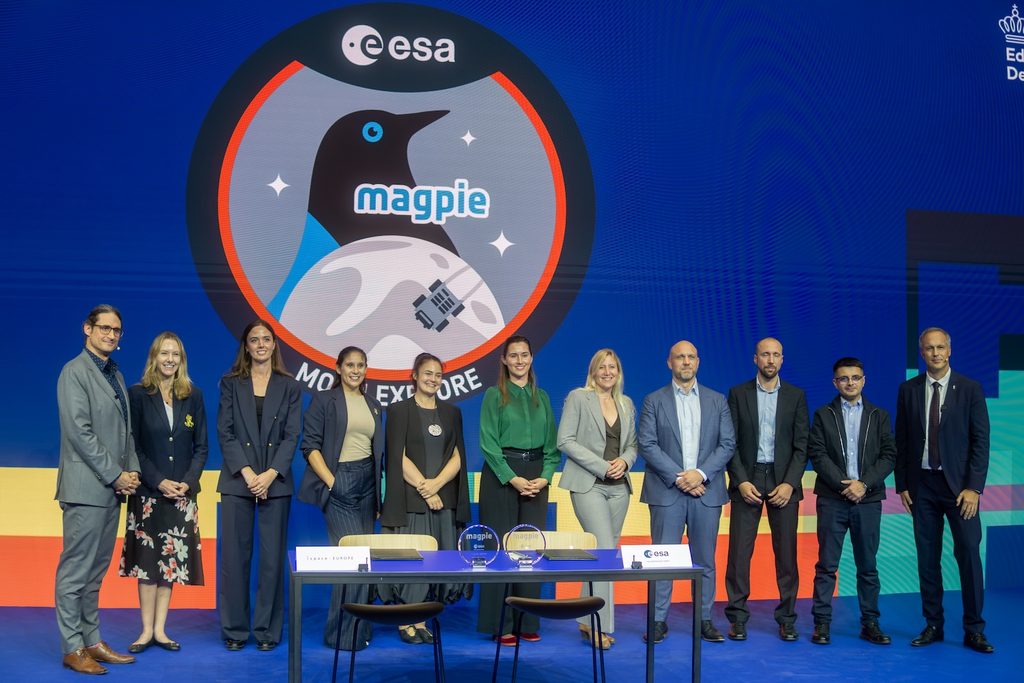
The MAGPIE Mission agreement signing ceremony led by Daniel Neuenschwander, ESA Director of Human and Robotic Exploration (right), and Julien Lamamy, CEO of ispace-EUROPE (left).

Representatives from ispace-Europe and the European Space Agency at the official signing ceremony.

The ceremony took place on the main stage at ESA Space for Inspiration 2026 in Copenhagen, bringing together senior representatives from ESA and ispace-EUROPE. The agreement was marked with a ceremonial signing by Daniel Neuenschwander, Director of Human and Robotic Exploration at the European Space Agency, and Julien-Alexandre Lamamy, CEO of ispace-EUROPE. It follows ESA’s July 2026 award of the €65 million Phase 2 contract to ispace-EUROPE. The contract funds the full remaining delivery of MAGPIE, including rover and payload development, manufacture, testing, transportation to the lunar surface, mission operations, and the provision of scientific data to ESA.

MAGPIE, Europe’s first lunar surface exploration mission scheduled to launch in 2029 on board ispace inc.’s Mission 4 ULTRA lunar lander, will investigate the Moon’s south polar region – focusing on the distribution and stability of water ice and other lunar volatiles, as well as the properties of the regolith. ispace, inc.’s Mission 4 lander will implement high precision landing under a grant awarded from Japan’s Space Strategy Fund Program administered by the Japanese Aerospace Exploration (JAXA). MAGPIE’s transport onboard Mission 4 is enabled through collaboration between ESA and JAXA.

Some areas near the lunar poles remain in permanent shadow and may preserve water ice over extremely long periods. Understanding how this ice is distributed, how it interacts with the surrounding terrain, and how it can be detected is an important scientific objective and foundational for future lunar exploration. Extracting water from the lunar surface will be key to enabling longer duration human exploration on the Moon and could provide the resource to fuel exploration further out into the solar system.

MAGPIE’s mobile platform will carry its instruments across the lunar surface, enabling data to be collected from multiple locations and across different terrain and geological features. Comparing measurements between these locations will provide greater insight into the spatial variability of volatiles, regolith properties, and geological conditions within the lunar south polar region. 

The resulting data is expected to improve scientific understanding of the lunar south pole while helping inform the technologies, operations, and mission architectures required for future resource prospecting and sustained activity on the Moon.

Led by ispace-EUROPE from Luxembourg, the MAGPIE consortium brings together scientific and engineering expertise from five European countries.

The consortium includes:

  • Technische Universität München, Germany – providing an instrumented drill Volatiles Sampler, as a part of the Lunar Volatiles Scout
  • ESR Technology, United Kingdom – providing a Drill Translation Unit, as a part of the Lunar Volatiles Scout
  • The Open University, United Kingdom – providing an Ion Trap Mass Spectrometer Volatile Analyzer, as a part of the Lunar Volatiles Scout
  • RAL Space, United Kingdom- leading the joint assembly and testing activities of the Volatile Analyzer with the support of Open University 
  • Centre for Space Sensors and Systems at the University of Oslo, Norway – providing the Lunar  RiMFAX Ground Penetrating Radar
  • Institute of Experimental and Applied Physics at the Czech Technical University in Prague, Czech Republic – providing a neutron spectrometer suite of Neutron HardPix and a Radiation HardPix

Together, the payloads are designed to examine the lunar surface and subsurface from complementary perspectives, connecting information about terrain structure, hydrogen-bearing material, and the composition of samples accessed by the drill.

The consortium model is central to MAGPIE’s wider significance. It brings together European science, engineering, and industry within a complete lunar surface exploration mission, creating practical experience across rover development, payload integration, testing, mission control and lunar operations.

Rover mobility will be essential to the next phase of lunar exploration. Alongside gathering data on the lunar environment, mobile systems can scout terrain, carry instruments between science locations, compare measurements across wider areas, and reduce uncertainty before more complex robotic and human operations begin.

Through MAGPIE, Europe will not only develop individual technologies but integrate them into a rover designed to operate as part of a complete lunar mission.

As prime contractor to ESA, ispace-EUROPE is leading the MAGPIE mission from mission design through to the delivery of scientific data, building on the experience gained through the development and operation of ispace-EUROPE’s TENACIOUS rover, launched onboard ispace Mission 2 in 2025 – the first European-designed, manufactured, and assembled lunar rover to launch into space.


“The Moon’s south pole is a key destination for future exploration. By prospecting for water and other volatile resources, MAGPIE will provide critical knowledge for the next phase of sustainable lunar exploration,” said Daniel Neuenschwander, ESA Director of Human and Robotic Exploration. “As ESA’s first lunar rover, MAGPIE brings together European expertise and international cooperation through our partnership with JAXA. Our decision to work hand-in-hand with a company such as ispace, with strong roots in Europe and Luxembourg, also highlights our revamped, cost-effective and fast-tracked approach to development.”

Julien-Alexandre Lamamy, CEO of ispace-EUROPE, said: “MAGPIE brings together the scientific depth, engineering capability, and commercial agility that Europe needs to build a sustained role in lunar exploration. By leading the mission from design and rover development through to operations and delivery of data, ispace-EUROPE and its partners are turning European expertise into real operational capability on the Moon.”

The MAGPIE mission team are now working towards the rover Structural Thermal Model readiness review, and will then work towards the next major mission milestone of Locomotion testing, focusing on rover mobility performance.

As MAGPIE progresses, the consortium will continue working closely with ESA to develop the rover, mature the payload suite, and prepare for mission and science operations at one of the Moon’s most scientifically important regions.

About ispace-EUROPE 

ispace-EUROPE, a lunar exploration company based in Luxembourg, focuses on the development of lunar rovers. It was responsible for the first-ever European designed, manufactured, and assembled lunar rover to launch into space; the TENACIOUS rover onboard ispace inc.’s Mission 2. With its world-class talent, robotics capabilities, and connections to the Luxembourg ecosystem, ispace-EUROPE is uniquely positioned to accelerate the creation of a lunar industry in Europe and serve the needs of the growing institutional and commercial customers.

About ispace, inc.

ispace, a global lunar exploration company with the vision, “Expand our planet. Expand our future.”, specializes in designing and building lunar landers, orbital transfer vehicles and rovers. ispace aims to extend the sphere of human life into space and create a sustainable world by providing high-frequency, low-cost transportation services to the Moon. The company has business entities in Japan, Luxembourg, the United States and Saudi Arabia, with more than 300 employees worldwide. For more information, visit: www.ispace-inc.com and follow us on X: @ispace_inc.

446 KB PDF
ESA and ispace-EUROPE Mark Official Signing of Europe’s First Lunar Polar Ice Exploration Rover Mission

Related articles

Mission
ispace-EUROPE and ALTEC Sign Memorandum of Understanding to Collaborate on Lunar Rover Testing
Learn More
Mission
Argo Space and ispace-U.S. Head to the Moon with Finalized Contract for Lunar Satellite Delivery “Mission 2.5”
Learn More
Mission
ispace Receives Grant for Japan’s Space Strategy Fund Project “High-Precision Landing Technology in the Lunar Poles Region”
Learn More

ispace Receives Grant for Japan’s Space Strategy Fund Project “High-Precision Landing Technology in the Lunar Poles Region”

TOKYO—August 7, 2026—ispace, inc. (ispace) (TOKYO: 9348), a global lunar exploration company, today announced that it has been awarded a grant for its “High-Precision Landing Technology in the Lunar Polar Regions” project, which was selected on Jan. 16, 2026, under Phase 2 of the Space Strategy Fund Program administered by the Japan Aerospace Exploration Agency (JAXA).

Project Title: High-Precision Landing Technology in the Lunar Polar Regions

Technology Development Objectives: High-precision landing near the South Pole of the Moon and payload deployment in the polar regions utilizing lunar communication relay satellites

Grant Amount: 11.6 billion yen

The maximum grant amount remains 20 billion yen. Since this figure is subject to change based on stage-gate reviews and other factors, it is not yet certain that the full amount will be received.

Background

Led by the United States, lunar exploration is currently accelerating rapidly. Following a December 2025 presidential executive order announcing the U.S. intention to develop a lunar base by 2030, in April 2026, NASA disclosed its plan for 20 lunar landing missions by 2028, and more than 70 missions during the next decade. Water resources are highly likely to be present in the permanently shadowed regions near the lunar south pole, and enabling high-precision landings at these locations is expected to advance future resource exploration and infrastructure development.

Ispace will conduct Mission 3 scheduled for 2028, utilizing its ULTRA lunar lander currently being developed with funding from Japan’s Ministry of Economy, Trade and Industry’s Small Business Innovation Research (SBIR) grant. Subsequently in 2029, the company will launch Mission 4 also with an ULTRA lunar lander, with the aim to acquire stable, high-precision landing technology for a landing near the lunar south pole. The area is believed to hold high scientific and economic value.

As part of the project, ispace intends to conduct a technology demonstration landing near the lunar south pole, an area extremely challenging location on the Moon. The technology developed and applied during the mission will be subsequently used for high-precision landings on a variety of other terrains and locations on the lunar surface. One expected usage is for landing in underground caves known as “lunar pits,” which exist in mid-latitude regions. These areas are attracting attention for their potential use as future living spaces and for their underground resources; high-precision landings near these pits could lead to new development opportunities.

Mission 4 will focus on developing advanced technologies for the long-term operation of ispace’s lunar lander fleet. During Missions 1 and 2, operations would have been limited to the lunar day when sunlight was available (approximately 14 days); however, in Mission 4, the goal is to conduct long-term operations (lunar night survival) in an environment near the South Pole where solar irradiation is expected from a horizontal direction regardless of day or night—similar to the conditions of the Arctic’s “white nights.”

Mission 4 is also expected to deploy a communications relay satellite into lunar orbit. The deployment will further establish the foundation for a communications infrastructure to support lunar activities, including the formation of a multi-satellite constellation and the provision of the “Lunar Connect Service” for data relay.

# # #

About ispace, inc. (https://ispace-inc.com)

ispace, a global lunar resource development company with the vision, “Expand our planet. Expand our future.”, specializes in designing and building lunar landers and rovers. ispace aims to extend the sphere of human life into space and create a sustainable world by providing high-frequency, low-cost transportation services to the Moon. The company has business entities in Japan, Luxembourg, and the United States with more than 300 employees worldwide. For more information, visit: www.ispace-inc.com and follow us on X: @ispace_inc.

63 KB PDF
20260807 SSF HPL Grant

Related articles

Mission
ispace-EUROPE and ALTEC Sign Memorandum of Understanding to Collaborate on Lunar Rover Testing
Learn More
Mission
Argo Space and ispace-U.S. Head to the Moon with Finalized Contract for Lunar Satellite Delivery “Mission 2.5”
Learn More
Mission
ESA and ispace-EUROPE Mark Official Signing of Europe’s First Lunar Polar Ice Exploration Rover Mission
Learn More

ispace Announces Q1 Financial Results for the Fiscal Year Ending March 2027

With expanding business opportunities in lunar infrastructure development, ispace is working to secure contracts for its next lunar mission and advance the development of its Cislunar business

TOKYO—August 7, 2026—ispace, inc. (ispace) (TOKYO: 9348), a global lunar exploration company, today announced its financial results for the first quarter of the fiscal year ending March 2026.

The year 2026 is proving to be a major turning point in lunar development. With NASA indicating a substantial increase in transportation demand for the construction of its Moon base, and the Japanese government establishing a 5.6 trillion-yen public-private investment framework for lunar exploration and low-Earth orbit technologies, the lunar transportation market is undergoing a structural shift from “one-off” exploration missions to sustained infrastructure demand with new market opportunities emerging in Japan, the U.S., and Europe. ispace aims to expand its business with “lunar infrastructure development” and “national security” as its two core growth pillars.

Against the backdrop of these changes in the business landscape, ispace is actively pursuing new contracts for Mission 5 in 2029, in addition to steady development of Mission 2.5, scheduled to deploy a lunar satellite, and lunar landing missions in Mission 3 and Mission 4, scheduled for 2028 and 2029, respectively. During the quarter, ispace launched a new lunar transport service utilizing SpaceX’s Starship and the in-house developed Mobile Cargo System, with global sales beginning upon its announcement.

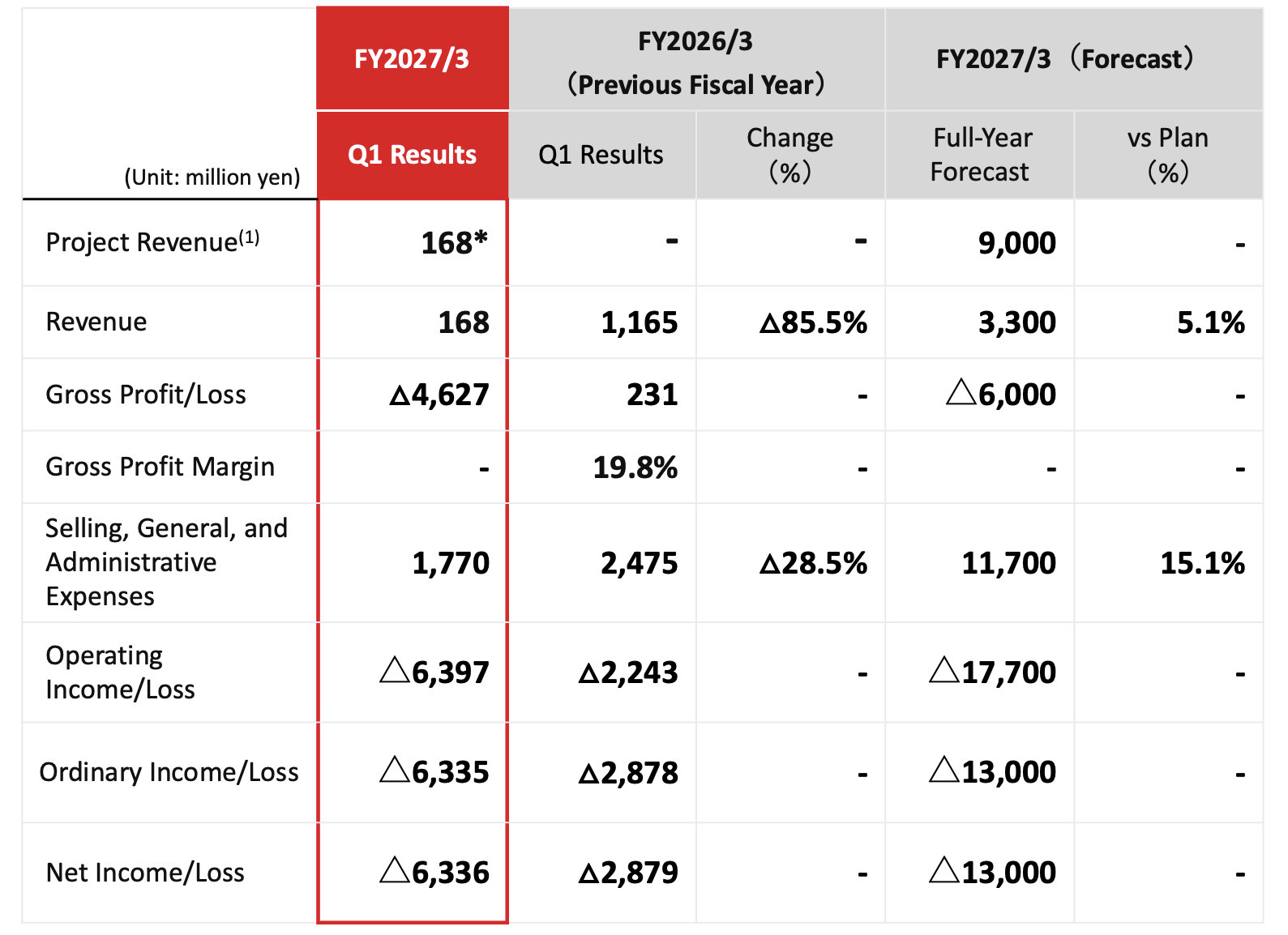
A summary of the income statement appears below. Based on contracts already secured and grants received, the company will recognize at least 46 billion yen in project revenue over the next four years. Specifically, for the current fiscal year, project revenue of 9 billion yen is anticipated, an increase of more than 50 percent year-over-year, driven by a Small Business Innovation Research (SBIR) grant for Mission 3 and the Space Strategy Fund grant for Mission 4.

Statement of Jumpei Nozaki, CFO & Executive Business Director of ispace

“We recognize that many shareholders and investors may be surprised by the numerous updates we’ve made during the quarter. This is evidence of the current global shifts in the lunar industry. While the termination of CP-12 is a negative, we view the major business opportunities we are now focusing on as extremely positive. As lunar development transitions from one-off exploration missions to a phase of ongoing infrastructure development, we will continue to drive the steady development of our lunar satellite, scheduled for launch as early as 2027 as part of Mission 2.5, as well as our lunar landing missions, Mission 3 and Mission 4, scheduled for launch in 2028 and 2029, respectively,” said Jumpei Nozaki, CFO & Executive Business Director, ispace, inc.

For details, please refer to the first quarter results for the Fiscal Year Ending March 2027 [Japanese GAAP] (Consolidated) document released today on ispace’s IR site. Additionally, the financial results presentation materials, recorded financial results briefing, and transcript of the financial results briefing will be available on the site.

IR site: https://ir.ispace-inc.com/jpn/news/

Overview

  1. First Quarter Results for the Fiscal Year Ending March 2027

Income Statement

  • Project Revenue: 168 million yen

Although not yet recorded in the profit and loss statement, the company received a subsidy of approximately 480 million yen in July, which is included in Q1, equivalent to approximately 640 million yen in project revenue for accounting purposes.

  • Revenue: 168 million yen

Revenue decreased compared to the same period last year. While revenue from Mission 2 and the former Mission 5 (CP-12) was recognized in the previous period, revenue for the current period is expected to be recognized sequentially based on customer acquisition for Mission 3 and development progress for Mission 4; the current period represents a “transition phase.”

  • Gross profit/loss: (4,627) million yen

Profit decreased year-over-year, primarily due to the recognition in Q1 of an impairment loss (approximately 3.7 billion yen) in cost of sales related to the integration of the lander models and engine changes in the U.S., as announced in March 2026. No additional impairment losses are currently anticipated, and progress is generally on track with the full-year forecast for this fiscal year.

  • Net profit/loss: (6,336) million yen

Net loss for the period decreased year-over-year, primarily due to the impairment loss mentioned above, despite the impact of foreign exchange gains. Note that the portion of SBIR grant revenue related to Mission 3 and the Space Strategy Fund grant related to Mission 4 scheduled to be received this fiscal year is expected to be recognized in a lump sum as non-operating income in Q4.  

Q1 Financial Results for the Fiscal Year Ending March 2027

2. Balance Sheet

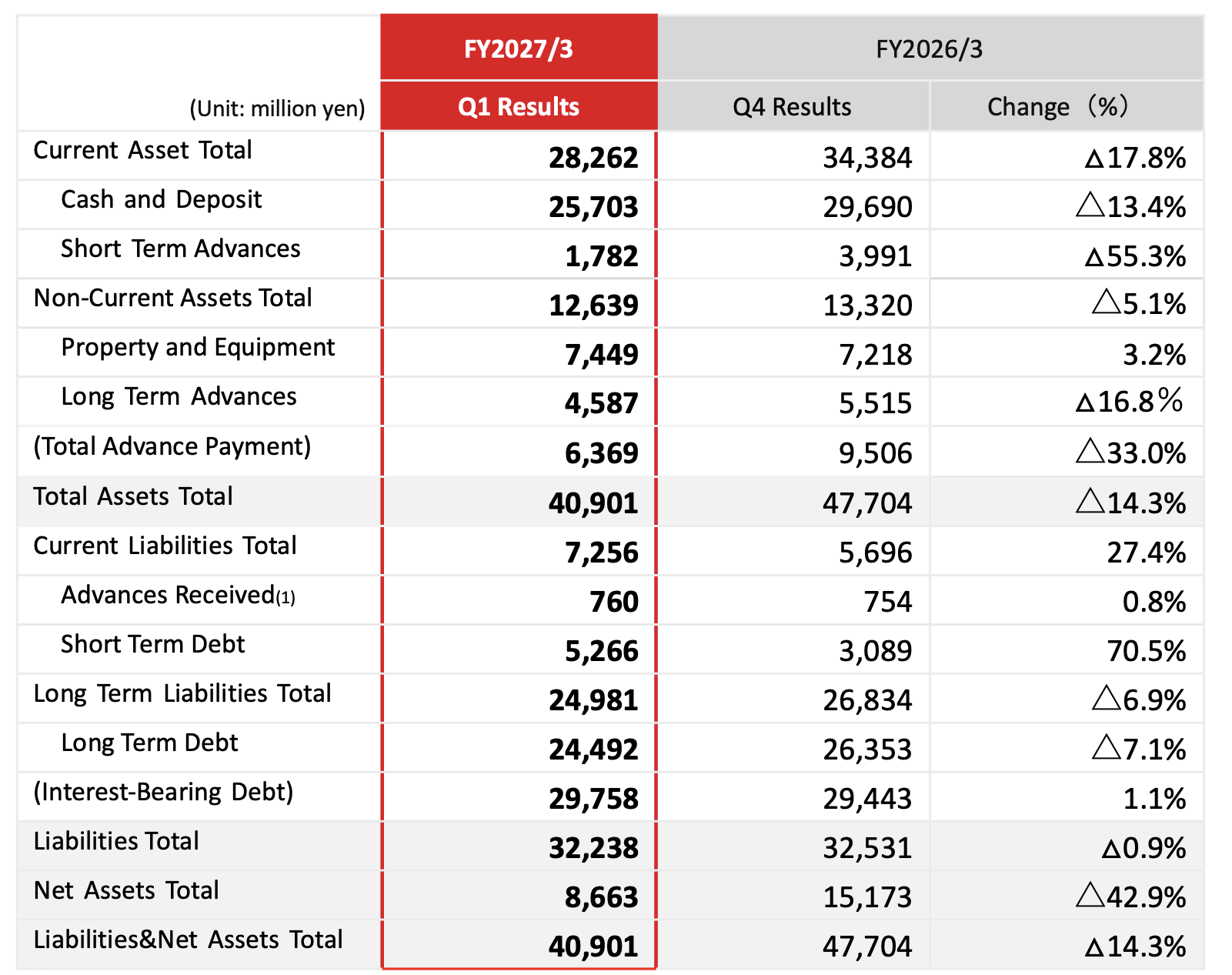
  •  Cash and Deposits: 25,703 million yen

As in the previous year, the company currently maintains sufficient liquidity on hand.

  • Advance Payments: 6,369 million yen

This figured decreased compared to the end of the previous fiscal year due to an impairment charge (approximately 3.7 billion yen) resulting from the integration of lander models and an engine change in the U.S.  

  • Interest Bearing Debt: 29758 million yen

Regarding short-term borrowings within interest-bearing debt, the company secured a 1 billion yen loan from Asahi Shinkin Bank in April 2026, resulting in an increase compared to the end of the previous fiscal period.

  • Net assets:  8,663 million yen

Net assets decreased, partly due to the impairment loss (approximately 3.7 billion yen) recorded by the U.S. entity in this first quarter. The company plans to continue prudent financial management to strengthen its financial stability.

Q1 Financial Results for the Fiscal Year Ending March 2027

For the cash flow statement and other financial statements for the fiscal year ending March 2026, please refer to the full-year financial results materials.

About ispace, inc. (https://ispace-inc.com)

ispace, a global lunar resource development company with the vision, “Expand our planet. Expand our future.”, specializes in designing and building lunar landers and rovers. ispace aims to extend the sphere of human life into space and create a sustainable world by providing high-frequency, low-cost transportation services to the Moon. The company has business entities in Japan, Luxembourg, and the United States with more than 300 employees worldwide. For more information, visit: www.ispace-inc.com and follow us on X: @ispace_inc.

513 KB PDF
20260807 Q1 Financial Announcement

Related articles

Finance
ispace Secures Approximately $19 Million in Bank Financing from Shizuoka Bank
Learn More
Finance
ispace Reports Full Year Financial Results for the Fiscal Year Ending March 2026
Learn More
Finance
ispace Recognized with DEALWATCH’s ‘2025 Equity Deal of the Year’ Award
Learn More

ispace Launches New Program “Engineering Master Program”

Certification for Outstanding Space Engineering Capabilities

Ryota Adachi Certified as the First “Black Belt Engineering Master”

TOKYO—August 6, 2026—ispace, inc. (ispace) (TOKYO: 9348), a global lunar exploration company, announced it has launched the “Engineering Master Program” as a new internal certification program to recognize engineers with outstanding space engineering capabilities and expertise.

This program recognizes the pursuit of mastery in specialized technical skills as a space engineer as a value. It aims to enhance the company’s internal environment so that engineers can pursue the ultimate level of expertise as a career path, thereby increasing intrinsic corporate value as an engineering firm.

Following a review by the company’s management, Mr. Ryota Adachi has been certified as the first recipient of the “Black Belt Engineering Master” (Japanese name: Kuroobi Engineering Master). Mr. Ryota Adachi currently serves as Manager of the Global Structure Design Group within the Global Design Office.

Since joining the company in 2019, Mr. Ryota Adachi has been consistently involved in the design of our RESILIENCE lander and is leading the mechanical design of the ULTRA lander, currently in development. He has made significant contributions to building the technological foundation for lunar landing missions. In receiving this recognition, he was commended for creatively solving advanced challenges—such as accelerating the design maturation process and developing an in-house landing impact analysis capability, which is key to lunar landing precision, throughout the evolution of our landers from RESILIENCE to ULTRA.

Ryota Adachi

安達 良太

Global Design Office 

Manager, Global Structure Design Group

Background

2007:               Worked at a Japanese company, primarily responsible for the design of industrial vehicles

2014:               Spent four years at the company’s U.S. office and factory as a design lead, working on quality improvements and manufacturing cost optimization for models intended for the U.S. market

2019:               Joined ispace. Assigned to the Structural Design Team, where he primarily worked on the structural design of the Mission 2 lander’s main structure

2023:               Appointed Manager of the Structural Design Team. Currently developing the main structure and landing legs for the lander for Mission 3 and beyond

The success of lunar missions requires advanced technologies that functions stably under the harsh, unique conditions of the lunar surface as well as engineering capabilities to creatively solve unprecedented challenges without being constrained by existing conventions or norms. The background behind ispace’s design of the “Engineering Master Program” is rooted in ispace’s management philosophy that “outstanding technical expertise is valued equally with the leadership required to guide an organization.”

Under the program, levels are established based on technical expertise and its impact both internally and externally to evaluate an engineer’s achievements. In addition to being awarded ispace’s official “Master” title, certified individuals will receive a stipend to support the further development of their expertise, as well as opportunities to share their knowledge. The “Black Belt Engineering Master” designation indicates a level at which an individual possesses advanced theoretical knowledge and highly specialized technical skills in a specific field, is capable of independently solving highly challenging R&D and technical problems, and can consistently and reliably produce results.

Statement of Takeshi Hakamada, Founder & CEO of ispace, inc.

 “The challenge of lunar development, a new frontier for humanity, cannot be realized without exceptional engineers. ispace’s new Engineering Master Program is designed to demonstrate to engineers that mastering technology is just as important as business and organizational management. We will continue to build the cislunar economy by creating an environment where talented engineers from around the world can gather and continue to take on new challenges together,” said Takeshi Hakamada, Founder & CEO of ispace.

# # #

About ispace, inc. (https://ispace-inc.com)

ispace, a global lunar resource development company with the vision, “Expand our planet. Expand our future.”, specializes in designing and building lunar landers and rovers. ispace aims to extend the sphere of human life into space and create a sustainable world by providing high-frequency, low-cost transportation services to the Moon. The company has business entities in Japan, Luxembourg, and the United States with more than 300 employees worldwide. For more information, visit: www.ispace-inc.com and follow us on X: @ispace_inc.

3 MB PDF
20260806 Master Program FINAL

Related articles

Corporate
ispace and ArianeGroup Sign Agreement for Strategic Collaboration to Advance Lunar Spacecraft Development
Learn More
Corporate
ispace, Leonardo and Telespazio Sign Memorandum of Understanding to Collaborate on Lunar Exploration
Learn More
Corporate
ispace Announces Reappointment of Board Members
Learn More

ispace and Mitsubishi Heavy Industries Agree to Launch Mission 3 ULTRA Lunar Lander Aboard H3 Rocket

First Japanese Lunar Landing Mission Launched by Japanese Rocket

TOKYO—July 29, 2026—ispace, inc. (ispace) (TOKYO: 9348), a global lunar exploration company, and Mitsubishi Heavy Industries, Ltd. (MHI) (TOKYO: 7011) announced today that the two companies signed a contract for launch and transportation services for ispace’s Mission 3 ULTRA Lunar Lander using MHI’s H3 rocket currently scheduled for 2028.

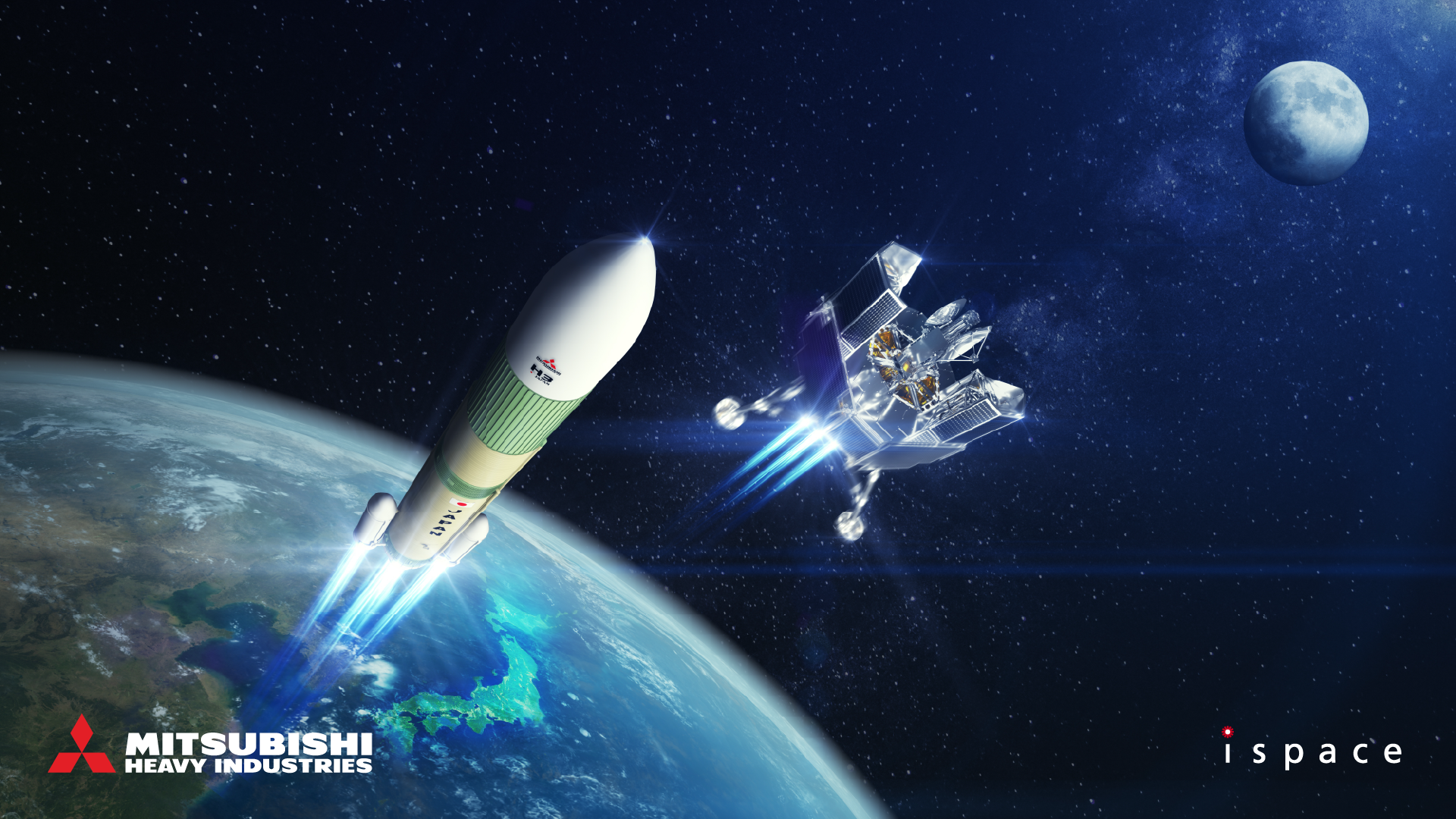
A computer-generated image of Mitsubishi Heavy Industries’ H3 rocket and ispace’s ULTRA lunar lander.

Through the agreement, ispace secures Japan’s most reliable launch capability provided by MHI and strengthens its framework to ensure the reliable execution and success of the ULTRA mission. The launch and lunar mission represent the first time a Japanese-made lunar lander and a Japanese-made rocket will work in tandem, taking a groundbreaking step in extending Japan’s space capabilities and industry to the Moon, symbolizing a new era of lunar exploration.

During its two previous lunar missions, ispace has demonstrated the ability to reliably reach lunar orbit while conducting months-long transport missions. Leveraging that mission operations experience and technical expertise, ispace is currently developing a new lander, ULTRA, with funding from the Ministry of Economy, Trade and Industry’s Small Business Innovation Research (SBIR) grant. ispace’s ULTRA, offering higher performance, higher quality, and faster access to the Moon, will be used to establish a high-frequency, low-cost transportation service to the lunar surface.

MHI is a core developer of Japan’s space industry for decades. Currently, the company is developing and manufacturing the H3 rocket, a next-generation heavy-lift launch vehicle that will replace the H-IIA and H-IIB rockets. Moving forward, the company will continue to support a wide range of space missions both in Japan and abroad by providing stable launch services using the H3 rocket and remains committed to the development of the space industry.

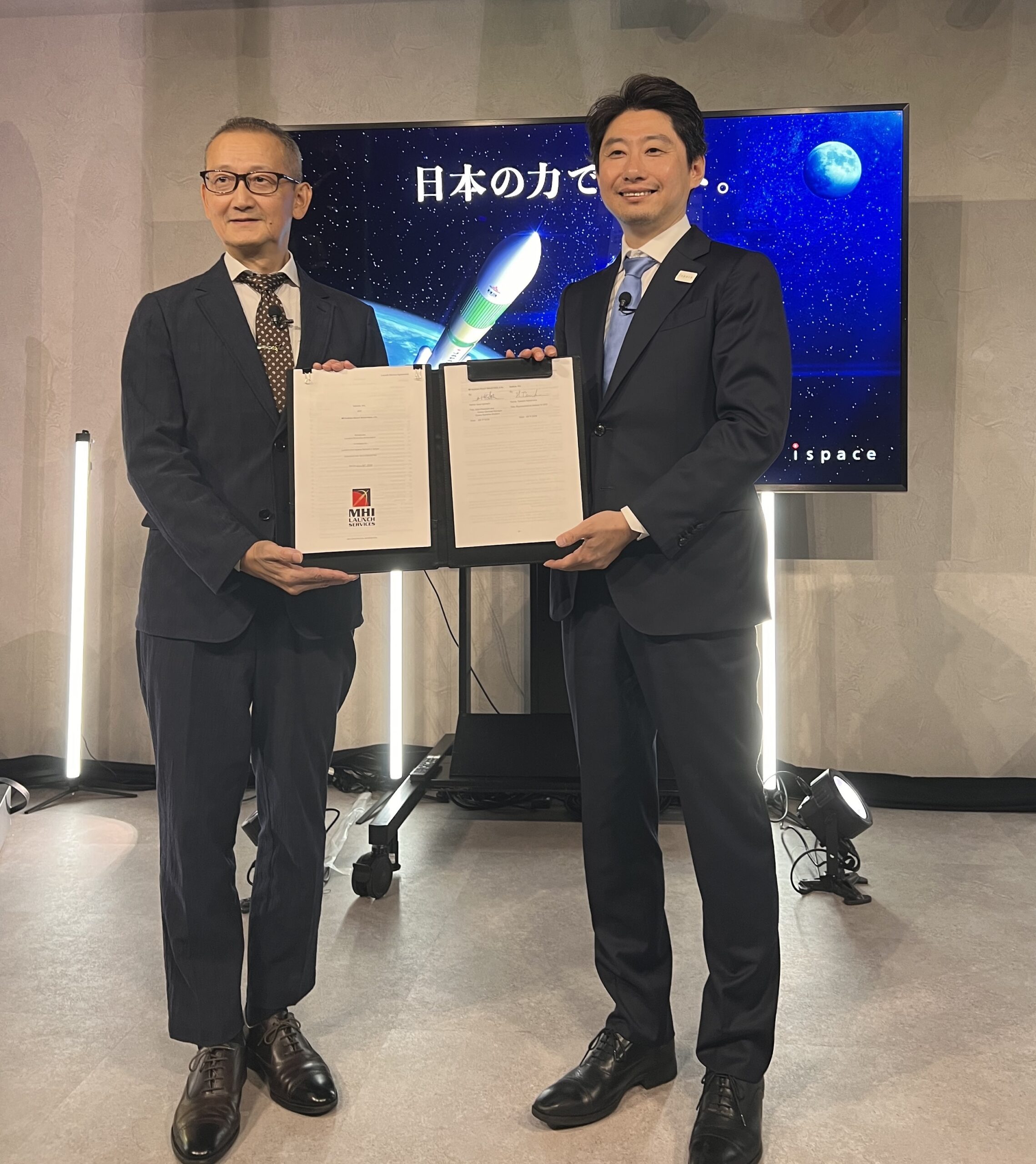
An image of Iwao Igarashi, Vice President & Senior General Manager, MHI and Takeshi Hakamada, Founder & CEO of ispace at a signing ceremony held at ispace headquarters in Tokyo, Japan.

Securing reliable launch services is an essential element for the stable growth of Japan’s space industry. Combining MHI’s proven launch technology with ispace’s track record in lander development and operations realizes a launch-to-landing lunar transport system via collaboration between the two Japanese commercial companies.

In addition, the two companies have agreed to explore ways to strengthen their cooperation not only in transportation services but also in the future construction of lunar infrastructure and related technologies. Together they will continue to promote the formation of a full-scale lunar transportation system that unites Japan domestic industries, thereby contributing to the expansion of Japan’s space industry infrastructure and the creation of the cislunar economy.

Statement of Takeshi Hakamada, Founder & CEO of ispace, inc.

“I am very pleased to sign this launch services contract to launch ULTRA using the H3 rocket. The fact that a lander developed by ispace will be carried aboard the H3 rocket, carrying forward the legacy of Japan’s domestically produced rockets with their proven operational track record, as it heads for the Moon symbolizes new possibilities for a Japanese private company to take the lead in advancing lunar development. The success of Mission 3 is a crucial milestone in ispace’s early commercialization phase, and I am confident that utilizing the H3 rocket will enable us to establish a reliable lunar transportation system,” said Takeshi Hakamada, Founder & CEO of ispace.

Iwao Igarashi, Vice President & Senior General Manager, Space Systems Division, Integrated Defense & Space Systems, Mitsubishi Heavy Industries, Ltd.

“It is a great honor for us to provide launch services for ispace’s Mission 3 ULTRA, using the H3 rocket. By leveraging the rocket technology and operational track record that Mitsubishi Heavy Industries has cultivated, we will contribute to the mission’s success by safely and reliably delivering the lander into space. With an eye toward new collaborations in private-sector-led lunar development, we look forward to working with ispace to pioneer new possibilities for Japan’s space industry,” said Iwao Igarashi, Vice President and Senior General Manager of Space Systems at MHI.

# # #

About ispace, inc. (https://ispace-inc.com)

ispace, a global lunar resource development company with the vision, “Expand our planet. Expand our future.”, specializes in designing and building lunar landers and rovers. ispace aims to extend the sphere of human life into space and create a sustainable world by providing high-frequency, low-cost transportation services to the Moon. The company has business entities in Japan, Luxembourg, and the United States with more than 300 employees worldwide. For more information, visit: www.ispace-inc.com and follow us on X: @ispace_inc.

About Mitsubishi Heavy Industries Group

Mitsubishi Heavy Industries (MHI) Group is one of the world’s leading industrial groups, spanning energy, smart infrastructure, industrial machinery, aerospace and defense.

MHI Group combines cutting-edge technology with deep experience to deliver innovative, integrated solutions that help to realize a carbon neutral world, improve the quality of life and ensure a safer world.

For more information, please visit http://www.mhi.com/ or follow our insights and stories on spectra.mhi.com.

4 MB PDF
20260729 M3 MHI Launch Agreement

Related articles

Mission
ispace-EUROPE and ALTEC Sign Memorandum of Understanding to Collaborate on Lunar Rover Testing
Learn More
Mission
Argo Space and ispace-U.S. Head to the Moon with Finalized Contract for Lunar Satellite Delivery “Mission 2.5”
Learn More
Mission
ESA and ispace-EUROPE Mark Official Signing of Europe’s First Lunar Polar Ice Exploration Rover Mission
Learn More